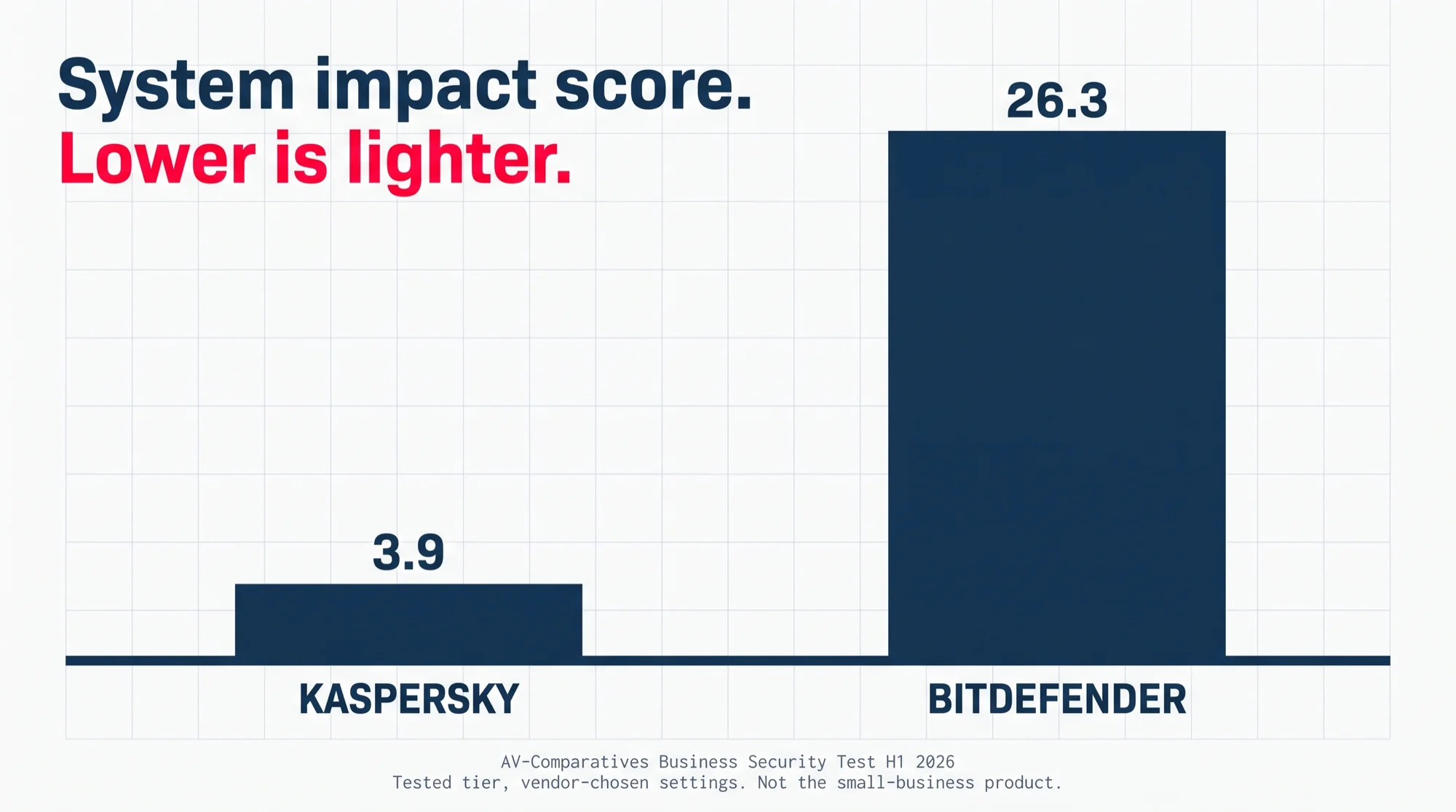
Two names on the shortlist, a handful of office machines, and a decision you would rather make once. Here is the answer up front. On the most recent business test from AV-Comparatives, an independent testing lab, Kaspersky and Bitdefender are level on protection: each blocked 399 of 400 live threats. The gap the lab did measure is weight on the machine. In the same report’s June 2026 speed test, Kaspersky scored 3.9 for system impact and Bitdefender scored 26.3, where a lower score means a lighter product. If your office runs laptops that are a few years old, that number is the decision. If the hardware is new, that gap matters less, and the choice comes down to how you buy and who sets it up.
One disclosure before the detail. xSquare resells Kaspersky and has set it up for tens of Singapore small businesses. We have never deployed Bitdefender. Every Bitdefender fact on this page comes from the lab report or from Bitdefender’s own pages, and none of it comes from our hands. Where that limit matters, we say so again.
Lab figures are from AV-Comparatives’ Business Security Test H1 2026, released 15 July 2026. Vendor pages checked 5 September 2026, and Bitdefender’s Singapore edition on 12 September 2026.
On protection, this is a tie
The lab put 400 live threats at each product between March and June 2026. Both stopped 399 of them.
| What was measured | Kaspersky | Bitdefender |
|---|---|---|
| Live threats blocked, out of 400 | 399 | 399 |
| Protection rate | 99.8% | 99.8% |
| False alarms in that test | 3 | 4 |
| Malware protection rate, March 2026 | 99.6% | 99.5% |
| False alarms on common business software | 0 | 0 |
A false alarm means the product blocked something harmless. Neither product raised one against ordinary business software, and every product in the test managed that. One threat out of four hundred is not a reason to pick a side, and neither is a single false alarm. Read those rows as a tie and spend your attention on the things that do differ.
One more fact from the same report, since picking the other vendor is often assumed to mean a different engine underneath. Cisco, G Data, SenseOn and VIPRE all use the Bitdefender engine alongside their own protection. Bitdefender’s detection sits inside four other products on that same list.
The measured difference is weight on the machine
The lab’s June 2026 test scores how much each product slows a computer down. Lower is lighter.
| Product | Impact score | Rank of 16 |
|---|---|---|
| ESET | 3.7 | 1st |
| Kaspersky | 3.9 | 2nd |
| Microsoft Defender Antivirus with Microsoft Endpoint Manager | 18.6 | 8th |
| Bitdefender | 26.3 | 11th |
Light is a vague word, so here is the measurement behind it. Kaspersky’s score is roughly a seventh of Bitdefender’s. The lab ran one baseline machine, an Intel Core i3 with 8GB of RAM and an SSD, and says its data “just gives an indication and is not necessarily applicable in all circumstances”. So read the gap as a ranking of sixteen products, not as a promise about your own laptops.
There is a fair caveat to set beside it. Both products were tested on settings their own vendors chose, not on what comes out of the box. The report lists eleven setting changes for Bitdefender, including its Sandbox Analyzer, SSL scanning, ransomware mitigation and command-line scanning, and two for Kaspersky. The report does not say the settings caused the gap, so neither do we. Read 26.3 as “Bitdefender, configured this way, was heavier in this test”, not as “Bitdefender is slow”.
The lab did not test what a small office actually buys
This changes how much weight the numbers above can carry. The products on the bench were Kaspersky Endpoint Security (Select, with KSC), which is the report’s own name for the version it ran, and Bitdefender GravityZone Business Security Premium. Neither is exactly the small-business product you would be sold, and the two sides are not equally far off.
Kaspersky’s small-business line is Kaspersky Small Office Security Premium and Kaspersky Next EDR Foundations, for companies of 1 to 100 employees. EDR stands for endpoint detection and response: software that keeps watch on each machine so that a security event can be seen and investigated. The report notes that the Kaspersky product it tested “might also be known as Kaspersky Next EDR Foundations”, so that side lines up closely. Bitdefender’s small-business product is GravityZone Small Business Security, for 1 to 100 devices, with Advanced Threat, Ransomware Mitigation and Fileless Attack Protection included. That is a different product from the Premium tier the lab ran.
The lab writes the warning itself: “Readers should not assume that the test results for one product in a vendor’s business range will necessarily be the same for another product from the same vendor.” So take the tie on protection as solid evidence about both companies’ engines. Take the impact score as close to the Kaspersky tier a small business would actually buy, on the report’s own note about that product’s name, and as a fact about the Bitdefender tier the lab ran rather than the Small Business one it sells.
Does the American ban on Kaspersky reach a business in Singapore?
The prohibition people have read about is American, and its own wording is about the United States and what it calls U.S. persons. We write that as American persons here. Whether a business in Singapore is caught by it is the next question.
The US Department of Commerce’s Bureau of Industry and Security issued a Final Determination against Kaspersky. Its page states that reselling, integrating or licensing Kaspersky’s cybersecurity or anti-virus software “is prohibited in the United States or by U.S. persons”. Two dates matter in it. From 20 July 2024, Kaspersky could not enter into new agreements with US persons for the transactions the determination lists. From 29 September 2024, it could not supply signature or codebase updates, and could not operate the Kaspersky Security Network “in the United States or on any U.S. person’s information technology system”. The determination does not apply to Kaspersky’s threat intelligence products, its security training, or consulting and advisory services that are purely informational or educational.
Read plainly, that is a rule addressed to the United States and to American persons. The page does not name Singapore. That is what the page says, and it is not legal advice.
The edge worth checking is the phrase about “any U.S. person’s information technology system”. If your company has an American parent, does American federal work, or manages machines belonging to American staff, put the question to whoever handles your compliance before you buy anything. Otherwise it is not your question, and it has not come up with our own clients. The businesses we would expect to care are the ones whose work runs mostly through American suppliers or American customers.
What Singapore asks of a small business, and the mistake that costs you the grant
Before “which of these two” there is a question with an official answer: what are you expected to have in place at all? Singapore’s Cyber Security Agency publishes the Cyber Essentials mark for exactly this, and its page, last updated 15 April 2025, says the certification has been enhanced to cover Cloud Security, Operational Technology Security and AI Security on top of classical IT security. The measures themselves are set out in CSA’s own infographic, linked from that page.
The money side sits next to it. CSA’s page on cybersecurity solutions under the Productivity Solutions Grant, a government grant usually called PSG, was last updated on 15 August 2026. It says CSA worked with the Infocomm Media Development Authority and Enterprise Singapore to line up the pre-approved solutions under the SMEs Go Digital programme, the government scheme that pre-vets digital tools for small companies, with the measures in the Cyber Essentials mark, and that eligible small companies can get PSG funding support for those solutions. The catalogue of pre-approved solutions sits on GoBusiness.
Then the trap, and it is the reason to read this before you buy anything at all. CSA lists what you must satisfy at the point of application, and it heads the list “For SMEs interested in adopting a cybersecurity solution”, naming an SME in three of the four:
- Your SME is registered and operating in Singapore.
- At least 30 per cent of ordinary shares are held, directly or indirectly, by Singaporeans or permanent residents as individuals. CSA calls this ultimate individual ownership: the shares have to trace back to people, not to another company.
- The solution is used in Singapore.
- You have not made any payment to a supplier, vendor or third party for that solution, and you have not signed any contract for it.
That last line ends the conversation for a lot of businesses. Buy the licence this afternoon and you have disqualified yourself from the grant on it. The order CSA gives is: look at the catalogue, get a quotation from a pre-approved vendor, then apply on the Business Grants Portal, which needs a CorpPass account, the login Singapore issues to a business for dealing with government agencies online. Whether Kaspersky or Bitdefender appears in that catalogue on the day you look is a question for the catalogue itself, and it takes two minutes to check.
Why neither company will quote you a price in Singapore dollars
Both companies put a buy button in front of a Singapore visitor. Neither puts a price beside it.
Kaspersky has no Singapore edition of its website. Its region picker lists Australia, India, Indonesia, Malaysia, New Zealand, Viet Nam, Thailand, Korea, China, Hong Kong SAR, Taiwan and Japan for this part of the world, and sends everyone else to the global site. The small-business page there carries a Buy Now button and no price at all. Bitdefender does publish a Singapore edition of its site, listed as “Singapore – English” in its country picker. Its small-business page there is a store with a “30% OFF” badge and the line “Taxes not included”, and it carries a placeholder where the figure belongs. Its American page reads the same way. So neither Bitdefender page shows a price, in Singapore dollars or in any other currency.
Which is why a Singapore buyer ends up talking to a person. That is a fact about how both companies sell here, not a complaint about either.
How that works on the Kaspersky side has changed, and this next part is our own experience rather than anything published. Kaspersky used to sell here only through its distributor and reseller network. It does not any more, and you can buy from Kaspersky directly. What you give up by buying direct is the person. Vendor support arrives by email and is pitched at a reader who already speaks its language. A reseller is usually an IT support outfit as well, which is why a company with nobody technical on staff tends to get further with one. We are a reseller, so weigh that accordingly.
Both companies have opened facilities in Singapore
The trust argument about Kaspersky is usually conducted in American terms. Locally it is more two-sided than that, because both companies have put something physical here.
Kaspersky announced a Transparency Center in Singapore on 16 June 2022, alongside new ones in Japan and the United States. It describes these centres as facilities where customers and partners can review “the company’s code, software updates, threat detection rules, and other activities”. Bitdefender announced a security operations centre in Singapore on 17 January 2024, to run its managed detection and response and its offensive security services for the region, alongside centres in the United States and Romania.
Both facts come from the company that owns them, which is the right source for a claim of that kind and also the limit of it. A building is not an audit result. It is a reason to treat the trust question as open on both sides rather than closed on one.
What actually goes wrong in a small office
Here is what we see on the Kaspersky side, across tens of Singapore small businesses.
The product is rarely the problem. The setup is. Most of our clients have no IT person, and a business security product is not consumer antivirus: it expects to be rolled out across machines and then configured. Owners get part of the way and stop. Or they finish the install and leave every default alone, because nobody is sure which settings matter. Companies that do have an IT person often hand it over anyway, because it is an afternoon they would rather spend on their own work.
Hold that next to the lab report, which is blunt about it. Its scores, it says, “were only achieved by applying the respective product configurations described here”, and it adds that “some enterprise products have all their protection features disabled by default, so the admin has to configure the product to get any protection”. A product nobody finished setting up does not score 99.8 per cent in your office. Whichever of these two you buy, the setup decides what you actually get. Our Google Workspace security checklist makes the same point about the email settings small companies never switch on.
So which one should you buy?
Three questions, in this order.
How old is your hardware? Weight is the single thing this report measured a real gap on, and Kaspersky sits at the light end of sixteen products. That was one lab machine, not yours, so read it as a ranking rather than a forecast. If the office computers already feel slow, start with the lighter product.
Is your work tied to the United States? An American parent, American federal work, or American staff whose machines you manage. If any of those is true, put the Kaspersky question to whoever handles your compliance first. If none is, the determination is written about the United States, not about you.
Who is going to set it up? If the honest answer is “nobody in particular”, that matters more than either score on this page. Buy from someone who will do the rollout and walk the settings with you, whichever product you end up with.
On protection this is a tie, and anyone who tells you there is a clear winner between these two has not read the H1 2026 report. We sell and deploy Kaspersky, so treat our preference as a preference, and note again that our hands-on experience stops at one of the two products on this page. We license and set up security software for Singapore small businesses, and the honest version of that job is matching the product to the machines and the people you actually have. Endpoint security is one layer. If your team runs Microsoft 365, our guide to Microsoft 365 security for small business covers the sign-in settings worth switching on first.
Sources
- AV-Comparatives, Business Security Test H1 2026 (March to June)
- US Bureau of Industry and Security, Kaspersky Lab, Inc. Prohibition
- Cyber Security Agency of Singapore, PSG Cybersecurity Solutions
- Cyber Security Agency of Singapore, Cyber Essentials
- Kaspersky, business security for small and medium companies
- Bitdefender, GravityZone Small Business Security
- Kaspersky, three new Transparency Centers (16 June 2022)
- Bitdefender, expanding managed security services in Asia Pacific (17 January 2024)