Yes. A Singapore company can claim what it paid for web design, the work to design and build its website. It cannot claim it as an ordinary expense, though. The Inland Revenue Authority of Singapore (IRAS) says a website counts as plant or machinery, its term for the equipment a business uses to do its work. So the web design cost is claimed as a capital allowance, a tax deduction for a business asset. The whole cost can be claimed in one year.
The rest of the bill takes other roads. The yearly care plan, the fee for keeping the site updated and backed up, is the kind of running cost IRAS lets a business deduct. Software renewals are deductible too, while software set-up costs are not. And if a government grant paid part of the web design cost, the amount you can claim may change.
This guide takes one real website bill and sorts each line under the IRAS rule for it. It is written for the director or bookkeeper of a small Singapore company who is closing the books before Form C-S, one of IRAS’s company tax returns, is due on 30 November. Our work is web design. We are not tax agents, the accountants who prepare and file tax for a business. Every rule here is IRAS’s own, and each one links to the IRAS page that states it.
Four terms come up again and again. Here they are in full.
- Capital allowance
- A tax deduction for the wear and tear of a business asset, such as a computer or a website. IRAS gives it in place of depreciation, which is not deductible.
- Revenue expense
- A cost of running the business day to day. IRAS’s examples are salaries, rent and utilities. It is deducted from income once it has been incurred.
- Year of Assessment (YA)
- The name IRAS gives each tax year. In IRAS’s own example, a company whose financial year ran from 1 January to 31 December 2022 is taxed on it in YA 2023.
- Form C-S
- One of the three Corporate Income Tax Returns IRAS names, beside Form C-S (Lite) and Form C. Your company files one of them each year. On IRAS’s overview of the three forms, Form C-S is for companies incorporated in Singapore with annual revenue of $5 million or below that meet its other conditions. Form C-S (Lite) is “a simplified version of Form C-S for smaller companies”, with revenue of $200,000 or below. Form C is open to all companies.
Read this as words instead
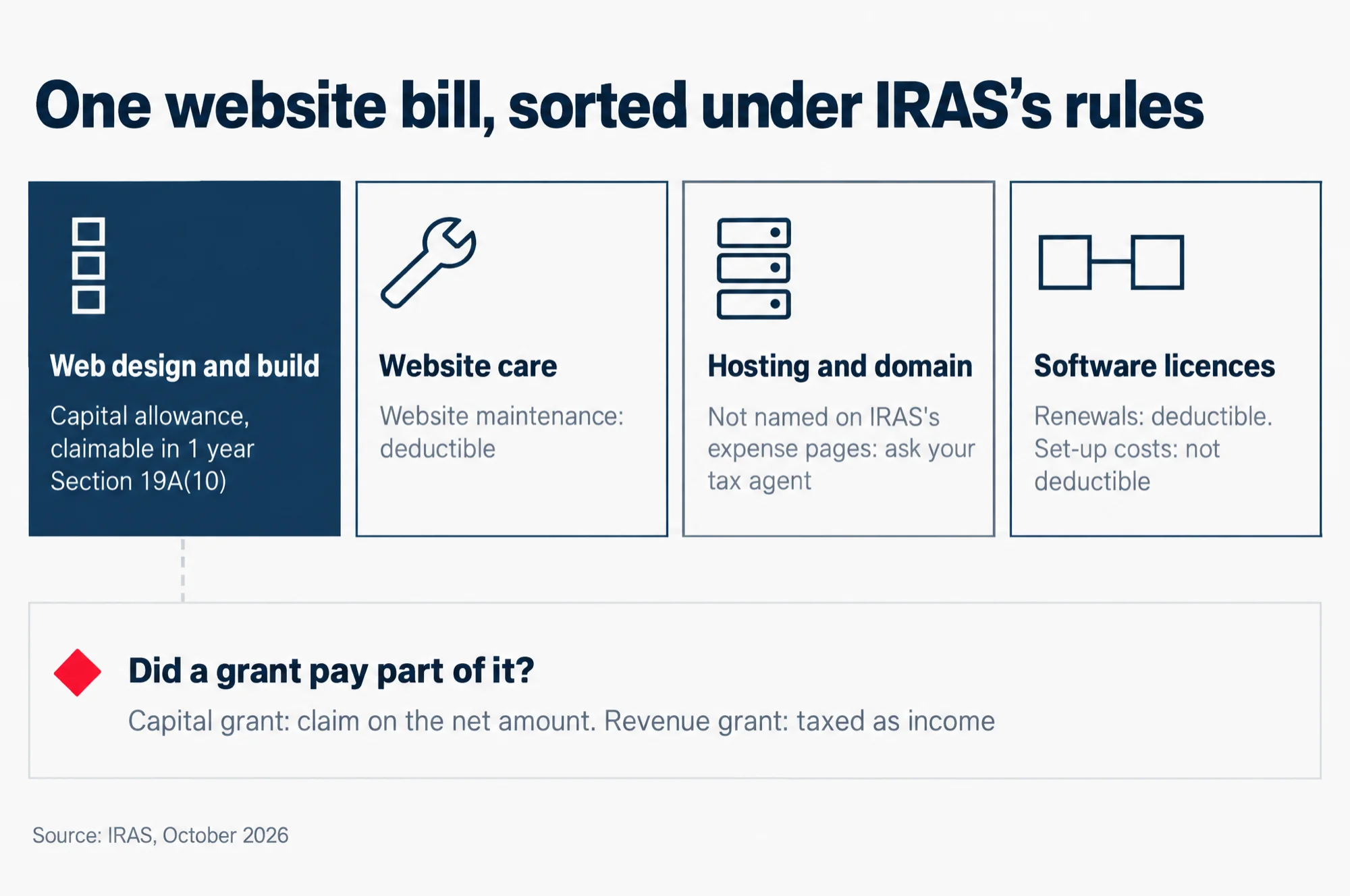
One website bill, sorted under IRAS’s rules.
- Web design and build: capital allowance, claimable in 1 year (Section 19A(10)).
- Website care: website maintenance, deductible.
- Hosting and domain: not named on IRAS’s expense pages, ask your tax agent.
- Software licences: renewals deductible, set-up costs not deductible.
Did a grant pay part of it? Capital grant: claim on the net amount. Revenue grant: taxed as income.
Source: IRAS, October 2026.
Web design: a capital allowance, claimed in one year
What you paid for web design is a capital cost. IRAS answers the question directly on its page on capital allowances: “Can my company claim 100% of the cost of purchasing or developing a website? Yes. A website qualifies as plant or machinery under Section 19A(10) and your company may claim capital allowance on the development cost or purchase cost of a website in 1 year.”
Section 19A(10) is the part of the tax law that holds this rule. In plain words, the tax rules treat your website the way they treat a computer on a desk: as an asset the company owns and uses, not as a bill for a service.
That means the web design cost does not go in the expenses.
IRAS’s list of non-deductible business expenses includes “Fixed assets acquisition cost (you may instead claim capital allowances)”. The web design cost goes on the capital allowance claim instead. Claimed in one year, the whole cost still comes off in a single YA. It simply sits on a different line of the tax computation. That is the working that turns the company’s profit into the income IRAS taxes.
Your accounts may spread the web design cost over a few years as depreciation. That does not change the tax claim. IRAS says depreciation in the financial statements is not tax-deductible, and the capital allowance takes its place.
Which year the web design cost falls in
IRAS ties the claim to when the cost is incurred, not when the money leaves the bank: “An expense is incurred when the legal liability to pay arises, regardless of the date of actual payment of the money.” In plain words, the cost counts from the day the company owes it, even if it pays later.
A web design project that starts and finishes inside one financial year raises no question. A larger one can cross your year end. Ours are paid in three stages: half at the start, 40% when design and development are signed off, and the last 10% at launch. If a project like that ran across your year end, ask your tax agent which part belongs to which year.
How the claim is made
The claim goes in your company’s Corporate Income Tax Return, its yearly tax return to IRAS, for the YA. Supporting lists, called schedules, sit in the tax computation behind it. One of them is a list of fixed asset additions: a short description and the cost of each new asset bought in the year. The website goes on that list.
Companies filing Form C file the tax computation with the return. On Form C-S or Form C-S (Lite), IRAS says to keep the tax computation and send it only when IRAS asks for it.
Hosting, the domain and the care plan: the running costs
Once a site is live, it keeps costing money every year. Those yearly fees are a different kind of cost from web design, and IRAS has a different test for them.
On its business expenses page, IRAS sets two tests for a deductible expense. It must be “wholly and exclusively incurred in the production of income”, which means spent only to earn the business’s income. And it must be revenue in nature, not capital. IRAS draws that line like this: revenue expenses are “costs incurred in the day-to-day operations of a business to generate revenue (such as salaries, rent, and utilities)”, while capital expenses “are investments in the business that are expected to provide long-term benefits”.
The care plan is the clearest case. IRAS’s factsheet for online businesses gives “the cost of maintaining a website” and “Internet subscription fees” as examples of deductible expenses. A care plan is website maintenance by name. Ours covers WordPress and plugin updates, daily backups, malware scanning (a search for harmful code) and uptime monitoring (a watch on whether the site is online). For the full list, see our guide to what a website maintenance service covers.
Hosting and the domain are less clear on paper. IRAS’s business expenses page and its factsheet do not name hosting or domain fees. They are yearly fees that keep the site online, which fits IRAS’s day-to-day test. That is our view, not IRAS’s wording, so ask your tax agent to confirm it.
One thing to watch on the first invoice. On some quotes, ours included, the first year of hosting, the domain, business email and the care plan sit inside the web design price. The invoice then shows one figure for two kinds of cost. Ask your tax agent how to treat that first-year share before you file.
Software: renewals, set-up and software you own
Business email and the other tools you subscribe to sit on a different line again. The same IRAS business expenses page has two lines for software licences: renewals and set-up.
Renewals are deductible. IRAS lists “License / software renewal costs” among deductible expenses. A Google Workspace or Microsoft 365 plan that you pay for month by month, or year by year, is a licence you keep renewing, so it sits closest to that line. To see what those plans cost, our page on Google Workspace pricing in Singapore lists the business plans in Singapore dollars.
Set-up costs are not. The same table puts “License / software set up costs” among the non-deductible expenses. A one-off fee to set software up is a cost to raise with your tax agent, not one to drop into the expenses.
Software you buy outright follows a third set of rules. IRAS’s table on the tax treatment of computer software splits it by what you own. To write off a cost here means to claim it against tax, over a set number of years. The section numbers name the part of the tax law each rule sits in.
- The right to use it, and nothing more. Boxed software, software downloaded from the seller, a site licence, or software that came on the computer. It is written off over 1 year, under Section 19A(2).
- Full ownership. You can change the program or license it to others. It is written off over 5 years, under Section 19B.
- Software built for you, in-house or by an outside firm. The development cost may be claimed under one of four other sections (14, 14D, 14DA or 14E), if its conditions are met. If not, it is written off over 1 year under Section 19A(2).
A website has its own rule, the one in the web design section above. On the WordPress sites we build, the paid plugin licences (add-ons that extend WordPress) from our own stack sit inside the care plan, so they are not a separate software bill.
One real website bill, line by line
Here is how that sorting looks on an actual quote. The bill below is for a business site from our web design and development service: a WordPress site of typically five to fifteen pages, at our prices on 7 October 2026.
| Line on the bill | Price | How often | How IRAS treats it |
|---|---|---|---|
| Web design and build | from S$5,450 | Once, paid in three stages | Capital allowance on the development cost, claimable in 1 year (Section 19A(10)) |
| First year of hosting, domain, business email and Website Care | Inside the web design price | With web design | One figure for two kinds of cost: ask your tax agent how to split it |
| Website Care, from year two | S$218 a month | Monthly | Website maintenance, which IRAS names as a deductible expense |
| Hosting, from year two | around S$262 a year | Yearly | Not named on IRAS’s expense pages; a running cost in our view, for your tax agent to confirm |
| Domain name, from year two | about S$65 a year | Yearly | As for hosting |
| Google Workspace accounts | Google’s price, not ours | Monthly or yearly | Closest to “License / software renewal costs”, which IRAS lists as deductible |
Read down the last column and the pattern is plain. The one large, one-time number is claimed as a capital allowance. The smaller numbers that come back every year are running costs. And the business email sits with the software renewals, at Google’s price.
If a grant paid part of it
A government grant can change the sum on the very bill you are closing. IRAS sorts grants into two kinds, and the two are taxed in opposite ways.
A capital grant shrinks the claim. This is a grant given to buy a business asset. IRAS says capital allowances “are no longer given on expenditure funded by capital grants from the Government or Statutory Boards that are approved on or after 1 Jan 2021”. Where a grant paid only part, you claim on the rest. IRAS’s own example: an asset costing $400,000, with a $100,000 capital grant, earns capital allowances on the net $300,000.
A revenue grant is taxed as income. On its page on taxable and non-taxable income, IRAS says a grant is taxable “if it is given to supplement trading receipts or to defray operating expenses of the company”. In the list on the same page, the Productivity Solutions Grant (PSG) appears as “Taxable as the grant is revenue in nature”.
Enterprise Singapore said PSG would cease on 29 September 2026, with grant applications going to the new EDGE Grant from 30 September. It also said PSG projects already under way would still be processed, so a PSG-funded web design project can still turn up in a company’s accounts after the grant itself has closed.
As of October 2026, IRAS’s list of grants does not name the EDGE Grant. So if EDGE money paid for part of a website, ask your tax agent which kind of grant it is before you file, and look at IRAS’s list again.
Records to keep, and for how long
Keep them for at least five years. IRAS’s record keeping page says a company must keep its records “for at least 5 years from the relevant Year of Assessment (YA)”.
Five years from the YA is longer than it sounds. In IRAS’s own example, a company with a December year end keeps the records for the financial year 1 January to 31 December 2022, which is YA 2023, until 31 December 2027.
IRAS names the kinds of record: source documents, accounting records and schedules, and bank statements. For a website, that means:
- the signed quote or contract, which shows what the web design work was and what renews
- every invoice, from web design to each renewal
- the receipts and proof of payment
- the bank or card statements the payments appear on
- if a grant paid part, the letter of offer and the claim papers, which show the grant’s amount and kind
Records you cannot produce can cost you the claim. IRAS says that where a company does not keep proper records, it may disallow expense claims and capital allowances, and impose penalties of up to $5,000.
Before 30 November: sorting your own website costs
IRAS’s due date for Form C-S, Form C-S (Lite) and Form C is “30 Nov each year“. Each of those returns is for one YA. IRAS’s basic guide to company tax says a company “is taxed on the income earned in the preceding financial year”. So the return due on 30 November covers a financial year that has already ended. A website bill dated in the financial year you are trading in now goes in a later return.
If a website bill sits in the year you are closing, here is a simple order to work in.
- Pull every website-related invoice dated inside the financial year: web design, the renewals and the software subscriptions.
- Mark each line as web design, running cost, software renewal or set-up fee, the way the table above does.
- Add the web design cost to the fixed asset additions in the tax computation, with a one-line description and its cost.
- Put the running costs and the software renewals in with the expenses.
- Where a grant paid part of a line, write down the grant’s name and amount beside it.
- Take every line you are unsure of to your tax agent before you file.
Step six is the one not to skip. The bundled first year, a web design project that crossed your year end and an EDGE-funded project are all questions for a tax agent, not for a web studio.
Next: read a real quote line by line
Whether you are closing the books on the site you have or pricing the next one, the quote is where the sorting starts. Our page on website design cost in Singapore lists each web design price apart from the yearly hosting, domain and care fees, so you can see which line of a real quote falls under which rule above before anything is signed.