A content strategy is the plan behind everything your business publishes. It decides who the content is for, what it must do for the business, which topics and formats you use, who writes and updates it, and how you judge whether it is working.
The plan comes before the writing. Kristina Halvorson, founder of the content agency Brain Traffic, set the idea out in a 2008 article for A List Apart, a magazine for people who make websites. Her definition is one line: “Content strategy plans for the creation, publication, and governance of useful, usable content.”
Governance is the one formal word in it. It means someone owns each page after it goes up. That person keeps it correct, and takes it down when it is no longer needed.
The part most worth keeping is the why. Halvorson wrote that the plan must decide “not only which content will be published, but why we’re publishing it in the first place.” Without that, she warned, it is “just a glorified production line for content nobody really needs or wants.”
Her 2009 book, Content Strategy for the Web, gives a longer version. Nielsen Norman Group, a research and training firm for people who design websites and apps, quotes it as “the ongoing practice of planning for the creation, delivery, and governance of useful, usable, and effective content”. The word to keep from it is “ongoing”. A content strategy is not written once and filed away.
Further down, one made-up small Singapore business works through a whole plan, so you can see what one looks like at your size.
How is content strategy different from content marketing and SEO?
Content strategy decides what to publish and why. Content marketing is the making and sharing of that content to win and keep customers. An SEO plan is the search work that helps the right pages get found. SEO is short for search engine optimisation.
| Content strategy | Content marketing | SEO plan | |
|---|---|---|---|
| The question it answers | What do we publish, for whom, and why? | How do we get it to the people we want as customers? | How do the right pages get found in search? |
| What you end up with | A short written plan: reader, purpose, topics, formats, who writes, how you check | Articles, posts, emails and videos going out | Pages Google can find, better titles and answers, pages for customer questions |
| When it comes | First, then reviewed | After the plan, week by week | Once there are pages for people to find |
Content strategy vs content marketing
Content marketing is the doing. The Content Marketing Institute, which publishes articles and research for people in content marketing, defines it as “a strategic marketing approach focused on creating and distributing valuable, relevant, and consistent content to attract and retain a clearly defined audience”. The strategy is what tells that work which audience, and why.
The two blur easily. Nielsen Norman Group says people “often confuse content strategy with content-related tactics”. Tactics are the hands-on jobs, such as copywriting (writing the words), making videos and posting on social media. Its answer is short: “A content strategy comes before tactics.”
The firm also found the blur in its own research. People working alone on content said they “were expected to author, edit, and market content”, which left them little time to plan. If you look after your firm’s website on top of your real job, that may sound familiar.
Is a content strategy the same as an SEO plan?
No. SEO is one part that a content strategy feeds.
Halvorson put SEO on her list of what a strategy defines, beside topics and purpose. She described SEO as editing and organising content “to increase its potential relevance to specific search engine keywords”. Keywords are the words people type into a search box. So SEO serves the plan. It does not replace it.
Google sets out the same order. Its guide to people-first content says “SEO can be a helpful activity when it is applied to people-first content, rather than search engine-first content.” People-first is Google’s term for content made mainly to help people. Search engine-first content is made mainly to climb the search results. The strategy decides the people and the purpose. The SEO plan then helps those pages get found. Our three-month SEO plan for small businesses is that second step, written for a business doing it alone.
What goes into a content strategy?
For a small business, a content strategy comes down to six decisions: who the content is for, what it must do, which topics, which formats, who makes and updates it, and how you judge it. Written down, the answers fit on one page.
Halvorson’s own list is longer. It runs from “key themes and messages, recommended topics, content purpose” through to SEO and more. A firm with one or two people writing can start with the six.
Start with what you already have. Halvorson wrote that a strategy is “necessarily preceded by a detailed audit and analysis of existing content”. A content audit sounds grand. For a small site it is a list of every page and post, what each one is for, and whether it is still right.
Google gives you a free test for most of the six. Its page on helpful, people-first content lists self-check questions, and says that answering yes to them “means you’re probably on the right track with a people-first approach”. The table pairs each decision with the Google question it answers.
| Decision | What you write down | Google’s question |
|---|---|---|
| Reader | Who reads it, and what they are trying to get done | “Do you have an existing or intended audience for your business or site that would find the content useful if they came directly to you?” |
| Purpose | What the content must do for the business, in one line | “Does your site have a primary purpose or focus?” |
| Topics | The questions your customers really ask | A warning sign if the answer is yes: “Are you writing about things simply because they seem trending and not because you’d write about them otherwise for your existing audience?” |
| Formats | The shape each topic takes, and how deep it goes | “After reading your content, will someone leave feeling they’ve learned enough about a topic to help achieve their goal?” |
| Who makes and updates it | Who writes, who checks, how often, and when each page is looked at again | “Does your content clearly demonstrate first-hand expertise and a depth of knowledge”, such as from having actually used a product or service? |
| How you judge it | One check you run at the end of each month | None. Google’s self-check list has no question about measuring results. So this decision uses Google Search Console, a free Google tool, instead. |
Read the topics row the other way round. That question sits in Google’s second list, where answering yes “is a warning sign that you should reevaluate how you’re creating content”.
An example of a content strategy for a small Singapore business
This example is an illustration, not a client. The business is made up: a small aircon servicing firm in the east of Singapore, run by the owner with one office staff member. Its website has a home page, a services page with prices, and a few old posts nobody has touched in years.
Here is how its content strategy comes together, one decision at a time.
What is already there
The owner lists every page on the site in a spreadsheet. One column says what the page is for. Another says whether it is still right.
The old posts are about a promotion that ended, so they come down. The services page shows last year’s prices. It gets fixed first, because it is the page that brings in bookings.
Reader and purpose
Reader: a home owner or tenant in the east whose aircon is dripping, noisy or not cooling, and who is deciding whether to call someone.
Purpose: more bookings for the jobs the firm does best, and fewer calls asking the same few questions.
Google’s audience question gets a clear yes. These are the people who already call the firm. They would find the pages useful if they came straight to the site, not only through a search.
Topics
The topics come from the phone and the WhatsApp chat, not from a keyword tool. For one month, the office writes down every question a customer asks. The six that come up most become the plan:
- Why is my aircon dripping water indoors?
- General service or chemical wash: which one do I need?
- How long does a service take, and do I need to be home?
- What does a yearly servicing contract cover?
- Is it worth repairing an old unit, or should I replace it?
- What can I check myself before I call?
None of these is a trend. Each one is a question the firm answers every week anyway, which is why Google’s warning question about trending topics gets a clean no. It is also the same move as month three of our SEO plan: one clear page per real customer question.
Formats
Each question gets its own page, with the answer in the first two lines and the detail below it. The last question, on what to check before calling, becomes a short how-to: a page of steps the customer can follow, with the owner’s own photos of a filter and a drain pipe. The prices stay on the services page, and every topic page links to it.
The pages work off the website too. When a customer asks one of the six questions on WhatsApp, the office replies with the link.
How deep each page goes follows Google’s question: will the reader “leave feeling they’ve learned enough about a topic to help achieve their goal”? For the dripping-aircon page, the reader’s goal is to know whether they can sort it out themselves or need a technician.
Who writes, and how often
The owner knows the answers. The office staff member has the time. So the owner records a voice note for each question, the staff member writes it up, and the owner checks it before it goes up.
That split keeps Google’s first-hand question honest. What is on the page comes from the person who does the work.
The plan says one new page every two weeks. The schedule lives in a shared spreadsheet. That is all an editorial calendar is: a list of the pages to come. Each row is one page, with who writes it, when it goes up and when it is next checked. Nielsen Norman Group suggests an editorial calendar “to plan and clearly communicate the creation, publication, and maintenance processes for content”.
A brief is the short note a writer works from: who the page is for and what it must answer. To brief each page, the staff member can use our free one-page content brief template (PDF). For the writing itself, our content writing tips for various forms of content are a place to start. If nobody in the firm has the hours to write, an outside writer can work from the same brief. Our content writing service for Singapore businesses does that job.
Updates are part of the plan, not an extra. When the firm changes a price or a service, every page that mentions it changes the same week. No page gets a new date without a real change, because Google lists “changing the date of pages to make them seem fresh” among its warning signs.
The check
At the end of each month, the owner looks at two things. Search Console shows which searches brought up the new pages, and how often people clicked. The phone shows the rest: are customers still asking the same six questions, or do they call having already read the answer?
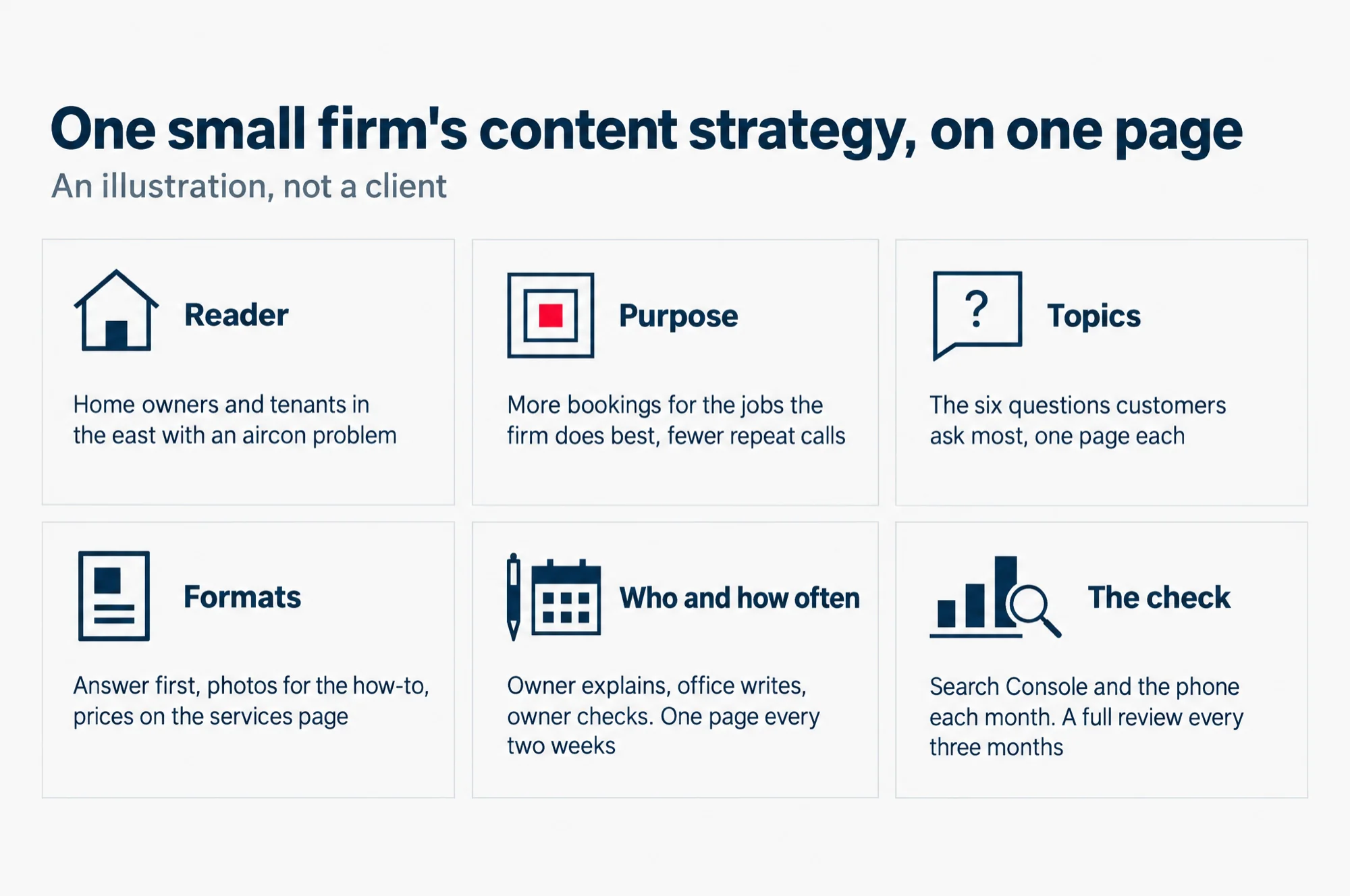
Read the one-page plan as words
One small firm’s content strategy, on one page. An illustration, not a client.
- Reader: Home owners and tenants in the east with an aircon problem
- Purpose: More bookings for the jobs the firm does best, fewer repeat calls
- Topics: The six questions customers ask most, one page each
- Formats: Answer first, photos for the how-to, prices on the services page
- Who and how often: Owner explains, office writes, owner checks. One page every two weeks
- The check: Search Console and the phone each month. A full review every three months
How do you know if the plan is working?
Look at the numbers once a month, and rethink the plan every three months. The monthly look is short. The three-monthly review is where you decide what to keep, fix or take down.
The monthly look happens in Google Search Console. Google describes it as “a free service offered by Google that helps you monitor, maintain, and troubleshoot your site’s presence in Google Search results.” It shows “which search queries show your site” and how often searchers click through. A search query is the words someone typed into Google.
Two words do most of the work there. Clicks are the times someone clicked through to your site from Google’s results. Impressions are the times your site appeared in those results at all. A page has to appear before anyone can click it, so impressions come before clicks. Look at both. They sit in the Performance report, the Search Console screen that shows how your site does in Google’s results. Our guide to reading the Search Console Performance report walks through that screen.
Search Console only sees Google. It cannot tell you whether the phone got quieter or the WhatsApp questions changed. That half of the check is yours.
Every three months, go back to the list of pages you made at the start. Nielsen Norman Group suggests you “start with at least a 3-month interval for reviewing content”. For each page, decide whether to keep it, fix it or take it down. Then check that the six decisions still hold. A new service, a new kind of customer or a question the phone keeps getting can each change the plan.
What to read next
A content strategy tells you what to write and why. Getting those pages found is the next job.
Our SEO plan for small businesses sets out three months of search steps on Google’s free tools: make sure Google can find your pages, improve the ones it already shows, then write for the questions your customers ask. The topic list from your plan is where its third month starts.