Content marketing is publishing useful material, such as articles, guides, emails and videos, that answers your customers’ questions, so they find you and trust you before they buy.
If your business already keeps a blog or sends a newsletter, you may be doing some of it. What makes it content marketing is the order of things. The piece helps the reader first. The sale, if it comes, comes later.
The Content Marketing Institute is an organisation that publishes research and runs training on this work. It defines content marketing as “a strategic marketing approach focused on creating and distributing valuable, relevant, and consistent content to attract and retain a clearly defined audience”.
Two phrases in that line are worth keeping. A “clearly defined audience” means you know who you are writing for before you write. “Consistent” means you keep going. One post a year is not a habit. A reader who finds a blog whose last post is years old learns something about the business, just not what you hoped.
How is content marketing different from advertising?
An ad pays for space in front of people and makes a claim about you. Content marketing makes your business its own publisher. It earns attention by being useful.
The Content Marketing Institute puts the difference in one line: “Instead of pitching products or services, a strategic content-driven approach provides relevant and useful content to your prospects and customers to help them solve issues”. Prospects are people who might buy from you but have not yet.
A search ad shows the paid side plainly. That is an ad that appears in Google’s search results. Google Ads is Google’s service for buying those ads. With it, you set a bid, which Google describes as “the maximum amount you’re willing to pay for a click on your ad”. So every visit an ad brings is one you paid for.
| Advertising | Content marketing | |
|---|---|---|
| Where it appears | Space you pay for on someone else’s website, app or screen | Your own website, your own email list, your own social media accounts |
| What it says | Why you should buy from us | The answer to a question the reader already has |
| How it gets attention | By being placed in front of people | By being worth finding, reading and passing on |
| What you pay for | The space, or each click on it | The time to make each piece, yours or a writer’s |
| When you stop paying | The ad stops showing | The page stays up and can keep answering the question |
The Institute’s own test is a good one to hold onto. It says the phrase “relevant and valuable” is the line between real content marketing and messages “sent by companies trying to sell first rather than help first”.
You do not have to choose one or the other. An ad can send people to a useful guide as easily as to a price list. The difference is what they find when they arrive.
What makes content useful? Google’s own test
Useful means the reader leaves with what they came for. Google publishes the questions it suggests you ask of your own pages, and they make a fair test for every form of content marketing.
Google calls this people-first content: “content that’s created primarily for people, and not to manipulate search engine rankings.” Search engine rankings are the order in which pages appear in Google’s results. Google wrote its questions for web pages. We use them for emails and videos too, because the test is about the reader, not the format.
Google’s page lists five questions, and says that answering yes to them “means you’re probably on the right track with a people-first approach”. Google last updated that page on 5 October 2026.
| Google’s question | What it asks of you |
|---|---|
| “Do you have an existing or intended audience for your business or site that would find the content useful if they came directly to you?” | Would your own customers want this, even if no search engine sent them? |
| “Does your content clearly demonstrate first-hand expertise and a depth of knowledge (for example, expertise that comes from having actually used a product or service, or visiting a place)?” | Does it show that you do this work yourself? |
| “Does your site have a primary purpose or focus?” | Do your pieces stay close to what your business actually does? |
| “After reading your content, will someone leave feeling they’ve learned enough about a topic to help achieve their goal?” | Can the reader act on it without looking elsewhere? |
| “Will someone reading your content leave feeling like they’ve had a satisfying experience?” | Was it easy and pleasant to get through? |
Google also lists warning signs. Answering yes to some or all of them, it says, “is a warning sign that you should reevaluate how you’re creating content”. Three of them bear straight on the forms below:
- “Are you producing lots of content on many different topics in hopes that some of it might perform well in search results?”
- “Are you using extensive automation to produce content on many topics?”
- “Are you mainly summarizing what others have to say without adding much value?”
Automation here means letting software make the pages for you. For a small business, the safe reading is simple. Write fewer pieces, about what you know, for people who already buy from you or might.
What types of content marketing can a small business run?
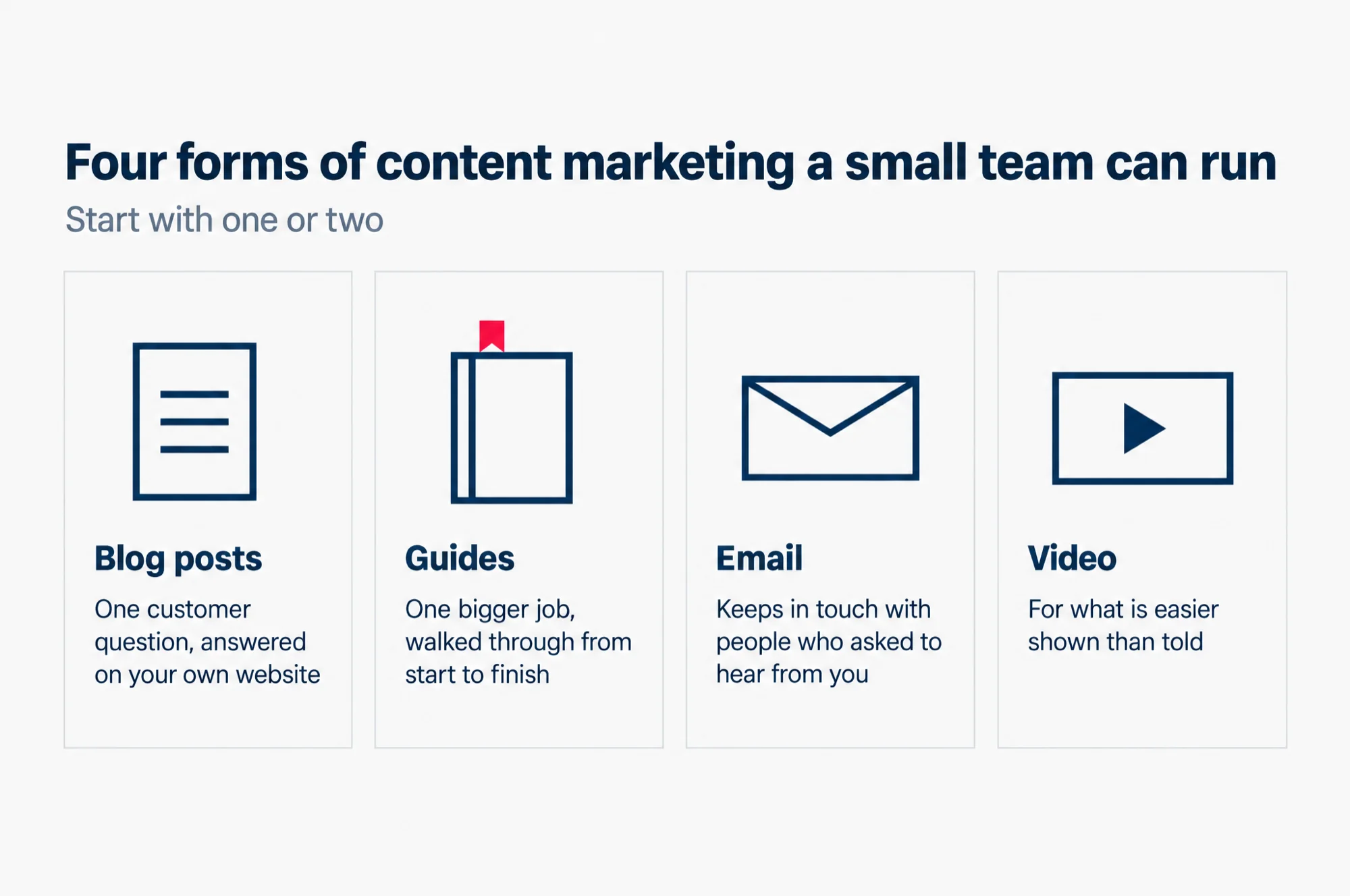
Four forms suit a small team: blog posts, guides, email and video. Start with one or two. Add the next only when the first is running without strain, because a form you cannot keep up fails the “consistent” part of the definition. Once you have picked, our writing tips for each form of content cover how to shape each kind of piece.
Read the four forms as words
Four forms of content marketing a small team can run. Start with one or two.
- Blog posts: One customer question, answered on your own website
- Guides: One bigger job, walked through from start to finish
- Email: Keeps in touch with people who asked to hear from you
- Video: For what is easier shown than told
Blog posts
A blog post answers one customer question on your own website. It suits the questions you hear every week. Say a tuition centre is asked, again and again, how it places a new student in a class. One clear post answers that for every parent who wonders, and the staff can send the link instead of typing it out.
Google’s learned-enough question is the one to test each post against. Will the parent finish the post knowing what happens next? If they still have to call to find out, the post is not done.
Our guide to using a blog to keep in touch with your customers goes further into what a blog can do for a small business.
You may be tempted to fill the blog with drafts from an AI tool. AI is short for artificial intelligence. Here it means software that writes text when you type a request. Google calls these tools generative AI.
Read Google’s own words first. Its page describes “using generative AI to produce large amounts of text without manual oversight or curation” as representing “little to no effort”. Oversight or curation means a person reading, choosing and fixing what the tool wrote. Google’s concern there is the missing oversight, not the tool. Our page on Google’s own rules for AI-written content sets them out in full.
Guides
A guide walks the reader through one bigger job from start to finish. It might be a how-to (a page of steps the reader follows), a checklist or a buying guide. It suits the question a customer asks before a large decision, such as what to prepare before a renovation contractor’s first site visit.
A guide asks more of you up front, and it has to be kept right afterwards. When a fact in it changes, the guide changes too. Google’s question here is whether the content provides “a substantial, complete, or comprehensive description of the topic”. A guide that skips the hard step fails that.
If nobody on the team has the hours to write a guide, an outside writer can work from your answers. Our content writing service for Singapore businesses does that job.
Email keeps you in touch with people who asked to hear from you. A short newsletter can carry your newest post or guide to customers who would never think to check your website.
Of all the forms, email fits Google’s audience question most closely. Everyone on a proper list came to you directly, by signing up. That is also why it needs care. A list takes time to build, and anyone on it can unsubscribe the day your emails stop being worth opening.
Email asks for three things: a list people signed up to, a tool to send with, and a steady rhythm. For the tool, our page on how to pick an email marketing tool for a Singapore small business compares the kinds on offer. It also covers the Spam Control Act. That is the Singapore law on what a marketing email must contain.
Video
Video is for what is easier shown than told: how a product is set up, what a finished job looks like, how a service works on the day. It speaks straight to Google’s first-hand question, because the viewer can see you doing the work.
It also asks the most of a small team per piece. A sensible first step is a short video added to a guide that already works, before you start a video channel of your own from nothing.
Is content marketing the same as digital marketing?
No. Content marketing is one part of digital marketing. Digital marketing is the wider set of ways a business markets itself online, and paid ads are part of it too.
Wikidata is a free public database of facts that anyone can check. It describes content marketing as a “type of digital marketing based on online content (text, video, audio and images)”. It does not have to be online, though. The Content Marketing Institute counts print beside email, social media, your blog and your website.
SEO is a separate job again. The letters stand for search engine optimisation. It means the work of helping your pages get found in search. Google describes it as the things you could do that are “specifically meant to help search engines better discover and understand your content”. Content marketing gives people something worth finding. SEO helps them find it.
Google puts the two in that order. In its words, “SEO can be a helpful activity when it is applied to people-first content, rather than search engine-first content.” Search engine-first content is the opposite of people-first: pages made mainly to rank in search, not to help a reader.
What to read next
Content marketing is the habit of publishing what helps your customers. Getting those pages found is the next job.
Our three-month SEO plan for small businesses sets out one search job a month, using Google’s free tools: make sure Google can find your pages, improve the ones it already shows, then write for the questions your customers ask. If you have just listed the questions your customers keep asking, that third month is where they go.