There is no single date for how long SEO takes. SEO is short for search engine optimisation: the work of helping Google understand your pages, and helping people find them through a search.
Google’s own answer on timing is a range. Some changes show in a few hours, others take several months, and you should wait a few weeks before you judge whether a change worked.
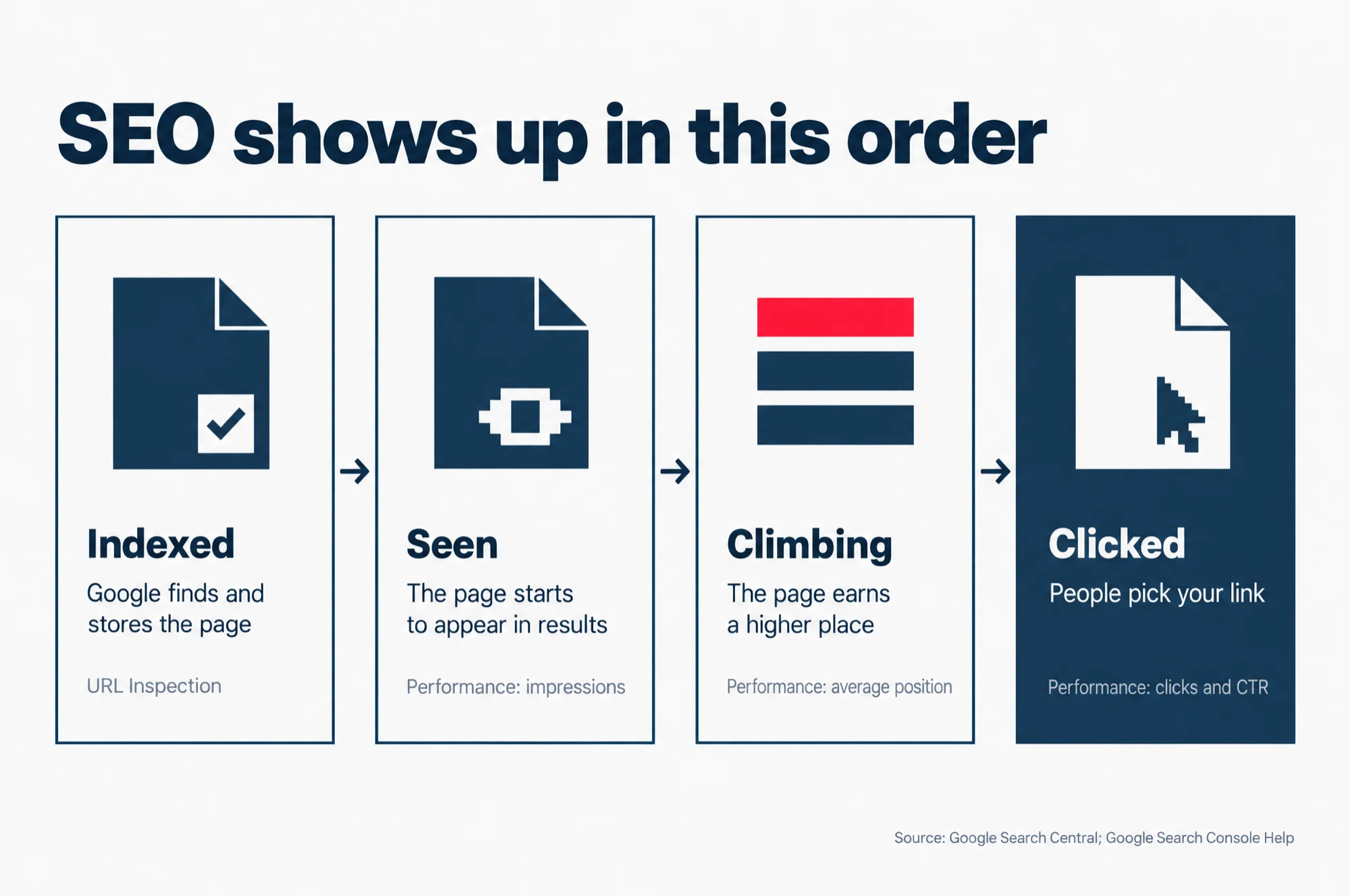
What you can know is the order SEO shows up in. First Google finds your page and indexes it, which means Google stores the page so it can show it in results. Then the page starts to appear in search results. Then it climbs. Clicks come last.
Each step shows up in Search Console, Google’s free tool for site owners. You can read it there yourself. You do not need to wait for a ranking report, the list an agency or a tool sends of where your pages place for chosen searches.
So “is my SEO working?” has a better question behind it: which step has each page reached, and is that step taking a normal amount of time? You can answer that page by page, for free.
What does Google say about how long SEO takes?
In its SEO Starter Guide, the basic guide Google writes for site owners, Google answers with a range and a piece of advice, not a month count:
Some changes might take effect in a few hours, others could take several months. In general, you likely want to wait a few weeks to assess whether your work had beneficial effects in Google Search results.
Google adds a caution that matters as much as the range: not every change you make will lead to a noticeable change in search results. If you are not happy with what you see, Google’s advice is to keep trying changes and see whether they make a difference.
Google gives the same advice to anyone hiring help. An SEO adviser may offer you an SEO audit, a review of your site. Google says that review “should be about giving you realistic estimates of improvement”. It also says plainly: “No one can guarantee a #1 ranking on Google.”
So treat any fixed promise with care. A date for page one is a guess dressed as a plan. A good adviser tells you which step to expect next, and when you can check it.
The four steps SEO shows up in, in order
Every page goes through the same four steps, and none can be skipped. A page that is not indexed cannot appear, and a page that does not appear cannot be clicked.
Step 1: Google finds and indexes the page (days to a few weeks)
Before anything else, Google has to know the page exists. It learns about a page in one of three ways: you send it a sitemap (a file listing your pages), you ask it to crawl the page, or it follows a link to the page from somewhere else.
Crawling means Google’s program visits the page and reads it. Indexing means Google then stores the page so that it can show it in results.
How long it takes Google to index a new page depends on when Google crawls it. Crawling “can take anywhere from a few days to a few weeks”. Once Google knows a page’s address, it “can take some time (up to a few weeks)” before Google crawls some or all of the site.
You can also ask Google to index one page. Once you ask, indexing “typically takes only a day or so, but can take much longer in some cases.”
What to open: the URL Inspection tool in Search Console. A URL is a page’s web address, so paste the page’s address in. “URL is on Google” means the page is indexed and can appear in results. Google adds that this does not guarantee the page is appearing.
For the whole site at once, the Page indexing report lists which pages are indexed and which are not, with a reason for each. Both screens are walked through in our guide to checking your website’s SEO for free with four Google checks.
Step 2: The page starts to appear in results
Once a page is indexed, it can start to collect impressions. An impression is counted each time a link to your site appears in someone’s Google results, whether or not they click it. Do not expect a high position yet, and do not expect clicks.
A few impressions and no clicks are normal here, and they are a good sign. They mean Google has matched the page to real searches.
Here is our own site at this step, for the 28 days to 27 October 2026: the search “how long does it take to see results from seo” showed xsquare.com.sg 2 times, with no clicks. Its average position was 41.5, which means our link sat around 41st or 42nd in the list of results.
What to open: the Performance report, the Search Console screen that shows how your site does in Google results. Open its Queries tab, which lists the searches people typed, or its Pages tab. Average position is the average spot of your highest result, so 1 is the top and 41.5 is well past the first page of results. Our guide to the Search Console Performance report, impressions against clicks explains every number on that screen.
Step 3: The position climbs (the slow part)
The page is indexed and showing. Now it has to earn a higher place than the other pages that answer the same search. Step 1 takes days to a few weeks, in Google’s words. So when a result takes several months, most of that wait sits here.
What to open: the same Performance report, filtered to one page. Set the date filter to a few weeks after a change and look at average position for the searches that page shows for. Read weeks, not days. Google says the newest data can be preliminary, “meaning it’s still being collected and might change in the next few hours”, so yesterday’s figure is not a trend.
Step 4: Clicks come
Clicks come last, because a person has to see your link before they can pick it. Click-through rate, shown as CTR, is your clicks divided by your impressions: the share of people who saw your link and picked it.
What to open: the Performance report again, this time with clicks and CTR switched on. Google’s tip here is specific: look for pages with many impressions and a low click-through rate, then check whether their titles and the short descriptions under them answer the question people searched for. That change can pay off sooner than most, because the page already has its place and only needs the click.
Read this as words instead
SEO shows up in this order
- Indexed: Google finds and stores the page. Check: URL Inspection
- Seen: The page starts to appear in results. Check: Performance: impressions
- Climbing: The page earns a higher place. Check: Performance: average position
- Clicked: People pick your link. Check: Performance: clicks and CTR
Source: Google Search Central; Google Search Console Help
Why SEO takes so long, and longer for a new website
SEO takes so long for two reasons. Each page has to pass the four steps in order, and Google sets the pace of the first one. Then, in step 3, the page has to earn a higher place than the other pages that answer the same search, and most of the wait sits there.
A new website takes longer, because it starts every page at step 1. Google has never seen the site, so it has to find it before anything else can happen. Google says so directly: if this is a new site or page, “it can take some time for Google to find and crawl new sites or pages.”
Two things help a new site through that first step. Google recommends making sure your homepage is indexed, because from the homepage it should be able to reach every other page, as long as the site’s menus and links lead there. And it calls a sitemap “very helpful if you just launched your site”. Neither makes Google faster. Both make it less likely that Google misses a page.
An older site that is already indexed skips most of that wait. When you improve a page Google already knows, the page does not start again from nothing. It is already indexed and may already have impressions, so the change works on steps 2 to 4. That is why the same SEO change can show in weeks on one site and take months on another, without either one being done wrong.
The search itself matters too. A search that many businesses already answer well is harder to climb than one few pages answer. If your page is up against established pages for the same words, expect step 3 to take longer.
Can you speed SEO up?
Only in step 1, and only a little. You can tell Google about a page sooner, with a sitemap or an indexing request. Past that, the timing is Google’s. Google puts it in four words: “Indexing is never instant”.
Asking again does not help. Google sets a quota, a limit on how many single pages you can submit for a crawl. And “requesting a recrawl multiple times for the same URL won’t get it crawled any faster.” A request also does not guarantee the page will be included “instantly or even at all.”
A paid promise does not help either. Google warns against anyone who claims to guarantee rankings, claims a “special relationship” with Google, or advertises a “priority submit” to Google, a promise to send your pages to Google ahead of others. There is no fast lane to sell.
Watch for a different clock. Google also rolls out changes to its ranking systems, the systems that decide the order of its results. It lists these changes as core updates and spam updates on its Search Status Dashboard, a public page that gives each update’s start date and how long it ran.
Each update takes time to roll out: the May 2026 core update began on 21 May 2026 and took 11 days and 21 hours to finish. If your numbers jump or dip during one, the cause may be Google’s change rather than your own SEO. Before you judge a change, check the dashboard for an update in the same weeks.
How do you know if your SEO is working?
Find the step each page has reached, then ask whether it has been there for a normal length of time. A new page with a few impressions and no clicks in its first weeks is where you would expect it to be. A page Google still has not found after a few weeks is worth a look, because that step is one you can usually fix.
| What you see | Where | What it means | What to do |
|---|---|---|---|
| The page is not in the report at all | Page indexing report | Google may not know the page exists yet, or a login or a noindex tag (a tag on the page that tells Google not to index it) is keeping it out | Run URL Inspection on it, link to it from your own pages, list it in your sitemap, and allow a few weeks |
| Discovered – currently not indexed | Page indexing report | Google found the page but has not crawled it yet, and rescheduled the visit | Wait. Google has it on its list |
| Crawled – currently not indexed | Page indexing report | Google read the page and did not add it. It may or may not add it later | Do not resubmit it; Google says there is no need. Make the page more useful instead |
| URL is on Google, with no impressions | URL Inspection, then Performance | The page is indexed but is not yet showing for anything people search | Check that the page answers a question people put into Google, in the words they use |
| Impressions at a low average position, no clicks | Performance report | Step 2. Normal, and early | Leave it a few weeks between changes, then compare |
| Many impressions, low click-through rate | Performance report | Step 4. People see the link and pass it by | Check the title and the short description shown under it, and rewrite them so they answer the search |
The table reads in one direction only. Work from the top: there is no point rewriting a title for clicks while Google has still not indexed the page.
If you are doing your SEO yourself, our three-month SEO plan for a small business spaces one job a month, so each change gets a few weeks before you judge it.
Before you pay for SEO help
Ask what the first three months will change, and which of these four steps you should be able to see by the end of them. A clear answer names screens in Search Console. A vague one names a ranking.
Then look at the length of the term. Google’s range runs to several months for a change to show, and you need a few weeks between changes to tell what worked. A term shorter than that ends before you can judge it.
Our SEO pricing page shows one such term in the open: two published prices on a 12-month term, with what each adds up to over the year, so you can compare it with any quote you get.