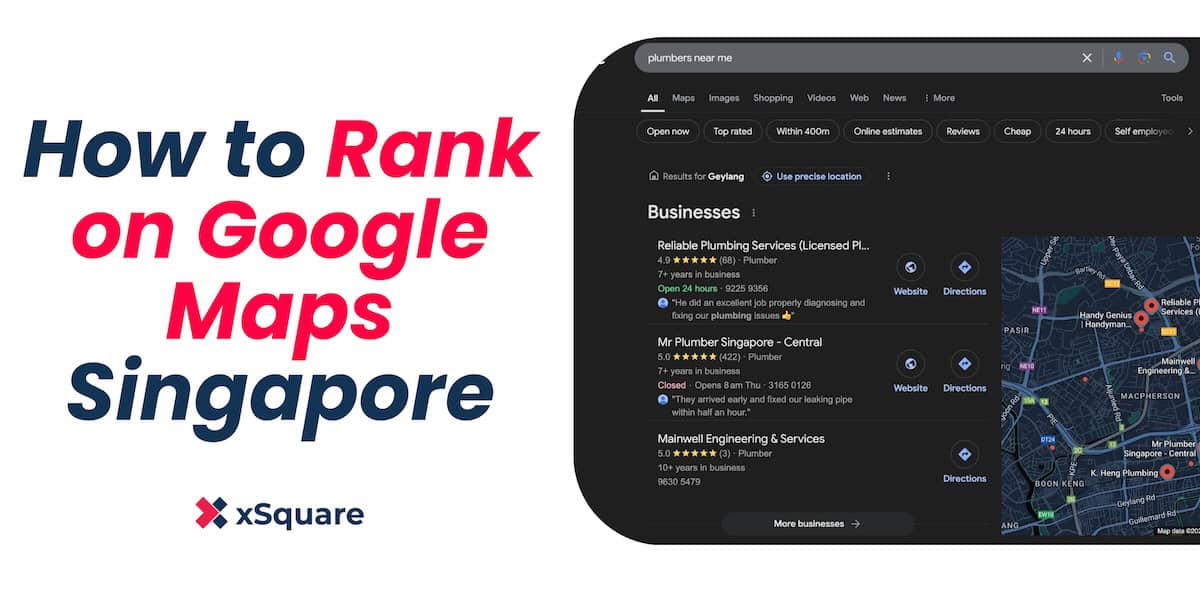
If you want to rank in Google Maps, a few things carry most of the weight. Your primary category. Your hours, and whether you are open when someone searches. Your services list. Your reviews. And whether your address is visible.
Most of the rest matters far less than the advice suggests. One popular tactic is being switched off by Google as you read this.
We know that advice pattern well, because we published it ourselves. This article replaces two of our own pieces: a 2025 Maps post and an unpublished 2026 guide. Both told you to fill in every field and post regularly. One recommended seeding your Q&A, which Google confirmed in December 2025 it is removing.
So here is what the evidence supports, what it does not, and what nobody can tell you yet. We also ran all of it against our own listing in August 2026. The last section is what we changed, including one decision we got wrong and reversed.
There is a two page checklist version of everything below. It is free to download and free to share. No email and no form.
Download the Business Profile checklistIt sits alongside our other free guides, all ungated the same way.
What Google actually publishes
Google names three local ranking factors. Relevance, how well your profile matches the search. Distance, how far you are from the searcher. Prominence, how well known you are. Google links prominence to your reviews and to sites that link to you. It also says plainly that “there’s no way to request or pay for a better local ranking on Google.”
The same page goes further than those three. It says complete address and hours, accurate categories and attributes, more reviews and better ratings, photos and videos, and replying to reviews “can help”. So Google does give field-level advice, and most of this article agrees with it.
What Google has never published is a ranked or weighted list. Every rank number here comes from the industry, not from Google. They come from the Whitespark Local Search Ranking Factors report, published 6 November 2025 for its 2026 edition. It surveys 47 local search experts who score 187 factors. Every rank below is the local pack and Maps score.
Two limits worth carrying through the whole article. **These are expert opinions, not measurements.** And the panel is mostly US-based. No Singapore or Asia-Pacific ranking data exists that we could find, so treat the numbers as a guide rather than a rule here.
The ranks, in one place
Every factor below is scored for Google Maps and the local pack, not for ordinary web results.
| Factor | 2026 rank | Change since 2023 |
|---|---|---|
| Primary category | 1 | Long-standing top factor |
| Physical address in search city | 4 | |
| Open at time of search | 5 | New this edition |
| Address shown, not hidden | 7 | |
| Additional categories | 8 | |
| Profile completeness | 16 | |
| Accurate hours set | 21 | Up from 85 |
| Predefined services listed | 22 | Up from 81, biggest rise in the survey |
| Photo and video quality | 45 | |
| Attributes | 81 | |
| Photo upload recency | 89 | |
| Owner-seeded Q&A | 142 | Feature being removed |
| Google Posts, frequency | 148 | |
| Google Posts, quantity | 168 | |
| Profile description | 171 |
What actually moves your ranking
Your primary category is the top factor. Not your description. Not your posts. If it is wrong or vague, nothing else you do will fix it. Your additional categories rank eighth.
Being open when someone searches is the fifth factor. It is new this edition and it is the cheapest thing here to get right. Having accurate hours set ranks 21st on its own, up from 85th. If your hours are wrong, you disappear at the exact moment someone wants you. Public holidays count.
Your services list rose from 81st to 22nd, the biggest jump in the survey. It is also the one item here with a real test behind it. Sterling Sky tested services in 2019 and found no effect. They ran it again in 2022 using specific services instead of generic ones, and rankings moved within 24 to 72 hours, for both the exact term and related phrases. Their article was last updated 27 February 2026. Use Google’s ready-made services where they exist, and be specific. The tested effect came from specific entries, not broad ones.
Reviews carry real weight and it is growing. The survey puts review signals at about a fifth of local pack weight, up from 16 percent in 2023. We could not check that exact figure against Whitespark’s own chart, and one summary of the report gives a different number, so treat the percentage loosely. The individual ranks are firmer. Ratings sixth. Reviews with actual text ninth. Review recency eleventh. A wall of five-star reviews from 2021 is worth less than a steady trickle this quarter. Replying is worth doing for trust, but the 2026 research does not list it among things that move rank. If you want the detail on asking for reviews without breaking Google’s rules, that sits inside our SEO work.
Your address matters twice. Having a physical address in the city being searched is fourth. Showing it rather than hiding it is seventh. More on this below, because it is also the riskiest decision here. Once the profile itself is right, the same address is worth putting on your own site too: see putting your Google Map location on your website.
What does not, and what to stop doing
This is where the evidence parts company with the standard checklist.
Your description ranks 171st out of 187. Google’s own help page for the field describes it as a way for customers to learn about your business, and says nothing about ranking at all. Sterling Sky has held since 2018 that it is an elevator pitch, not a ranking lever, and has not changed that position. Write it well, because people read it. Do not stuff keywords into it. That breaks Google’s rules whether or not it works.
Google Posts rank 148th for frequency and 168th for quantity. Posting regularly is among the most repeated pieces of Business Profile advice, including in the post this article replaces. It sits near the bottom of the list. Posts do feed engagement signals, which the survey shows are rising in importance, so they are not useless. They are simply not the ranking lever they are sold as.
Q&A is being removed, so stop seeding it. Google confirmed on 3 December 2025 that the Q&A section is being replaced by an AI tool called Ask Maps. Gemini answers questions by reading your profile, website and reviews, instead of showing a public thread. The API was retired on 3 November 2025. Owner-seeded Q&A ranked 142nd even before this. Any guide telling you to add your own questions is describing a feature that is going away.
Chat has been gone since July 2024. Customers could no longer start new chats from 15 July 2024, and it left the dashboard on 31 July 2024. The 2025 replacement is much smaller: a button that opens WhatsApp or an SMS, not an inbox inside Google. It is only offered in some regions, so check your own dashboard rather than assuming. If you add both WhatsApp and SMS, only the SMS button shows. This is a good staleness test. If a guide tells you to switch on Business Profile messaging, it is at least two years old.
Attributes rank 81st. Fill them in accurately so you match filtered searches. Do not expect them to lift your general ranking.
Photos are middling, and it depends on your industry. Quality ranks 45th, upload recency 89th. Sterling Sky studied 8,186 businesses and published the results on 5 November 2025. Photo recency correlated with better rankings mainly in visual categories such as restaurants and salons, with little measurable effect elsewhere. That is a correlation, not a controlled test. If you sell a service rather than a room, an aggressive photo schedule is not where your effort belongs.
The completeness paradox
One number in the same survey looks like it contradicts all of this. **Profile completeness ranks 16th**, inside the top nine percent of 187 factors. Better to face that directly than let a reader find it.
Both things are true, and the field-level ranks explain the composite one. Completeness scores well because the fields inside it include category, hours and services, which rank 1st, 21st and 22nd. That does not mean every field counts equally. The same survey puts description at 171st and posts at 168th.
Fill your profile accurately, yes. Treat completeness as a ranking strategy, no. The question is never “is my profile full” but “are the right parts of it correct”.
Two changes that carry real risk
Everything above is safe to change, with one exception. Category is one of the three core fields that can trigger re-verification, so change it on its own. These next two carry more than that.
Hiding your address can remove you from the local pack
Sterling Sky published a controlled test in October 2024. They recorded a home services business’s rankings with its address visible, hid the address, tracked it for about a month, then restored it. While hidden, rankings fell, calls dropped, and **the local pack disappeared completely** for the main keywords. Results reverted to ordinary web listings. Restoring the address brought both back. They validated it against a second location.
Two caveats. Sterling Sky said results varied between clients, with some seeing a dramatic effect and others almost none. And the point is contested. A practitioner in the same forum discussion argues there is no built-in disadvantage, because Google anchors distance to the address you verified at, whatever is displayed. Google documents nothing either way.
There is a second risk that most write-ups leave out. Hiding a shown address counts as an address change, so it can trigger re-verification. Some accounts find the setting locked until their verification is current. That matters, because “just switch it back if it hurts” may not be available when you want it.
Worth saying why people want this. Plenty of small businesses, solo operators and freelancers are registered at home. A residential pin on a public map is more exposure than some people signed up for. That is a fair concern. It has one answer that works and one that will get you suspended.
A virtual office or mail-forwarding address does not work. Google is explicit. A rented mailing address you do not actually operate from “isn’t eligible for a Business Profile”. PO boxes and mailboxes at remote locations “aren’t acceptable”. A co-working office only counts if it “maintains clear signage, receives customers at the location during business hours, and is staffed during business hours by your business staff”. A hot desk does not meet that. Practitioners report this as a common cause of suspension, and a hard one to reverse.
This is not the same as your ACRA registered office address. That is needed to register your company and is perfectly normal. It just does not make an address valid for Google, which is asking a different question: can a customer turn up and find you there during your opening hours.
The service-area route does work. Hiding your address is a supported setting. Google’s own rule is to use it only if you are a service-area business, which a home-based studio genuinely is. You still enter the address, and Google still verifies you at it. It simply is not displayed. The cost is the ranking risk above, which is real.
So the trade is not privacy against nothing. It is privacy against local pack visibility, using a setting Google supports, instead of an address workaround Google rejects. If you work from home and are comfortable showing your address, the ranking case favours showing it.
If you go ahead: screenshot your rankings first, change nothing else at the same time, have branding evidence ready in case you are asked to verify, and expect that reversing it may not be instant.
One related point that is better settled. The service area you declare, meaning which suburbs you list, does not appear to affect ranking. Sterling Sky found in March 2025 that its effect is visual only, and that ranking anchors to the address you verified at. Two senior practitioners have disagreed publicly in this area. We follow the side whose test has a documented method.
Renaming can trigger re-verification, even when the new name is more correct
Google’s naming rule is about the real world, not your ACRA record. Your profile name should be the name “used consistently on your storefront, website, stationery, and as known to customers”. Trading names that differ from your registered entity are explicitly allowed. Legal suffixes are listed as not acceptable unless you can show they genuinely appear in your branding. So if you trade under a brand, the suffix probably should not be in the field.
Removing it is usually the compliant move. The catch is that Google acknowledges a name change after verification may mean verifying again, and publishes no threshold for what triggers it.
What practitioners consistently name as the risk amplifier is stacking sensitive edits. Changing name, address and category in one sitting is the pattern linked to suspensions. A single edit that aligns the field to a trading name you have used for years is the low-risk category. We could find no documented case of a profile suspended purely for one honest, keyword-free name correction. That is an absence of evidence, not a guarantee.
If you do it: make sure your website and invoices already show the name, change only that field, change nothing else that week, and have branding evidence ready in case Google asks for video verification.
Verification, and why you may be seeing more of it
In the keyword data we pulled for this article, Singapore searches for Business Profile verification terms are up roughly fivefold year on year, though from a small base of about 30 searches a month. Trade coverage through 2025 and 2026 also reports more aggressive automated review and slower appeals. Those sources are secondary, and we could not verify the strongest of them.
The practical version is simple. Re-verification is triggered by edits to core fields, most reliably your name, and by Google’s own account your address and category too. You cannot control whether you are asked. You can control whether you are ready. Have your registration record, and photos of signage, invoices or branded materials that match your profile name, before you edit rather than after.
What we changed on our own listing
We audited our own profile against all of this in August 2026. Four things came out of it, and one was us being wrong.
Our hours were wrong, and had been for a long time. The profile said we opened at 9am. Our own website has published Monday to Friday, 10am to 6pm in its structured data for months. Being open at search time is the fifth factor and hours accuracy is 21st, so this was the cheapest fix available and the most embarrassing to find. It took two minutes.
We removed a category we no longer wanted. The listing carried IT support alongside web design. We had already decided to stop taking new IT support customers, so the category was advertising something we did not want to sell. The set is now website designer as primary, plus internet marketing service and e-commerce agency.
We planned to hide our address, then reversed it. Hiding it looked like privacy at no cost. The Sterling Sky test says otherwise, and “address in search city” being a top-five factor made the trade explicit rather than free. We kept it visible. We had made that decision and then unmade it after reading the evidence, which is why it is here.
We are renaming, carefully. Our profile carried our registered entity name including the legal suffix, while everything customer-facing uses the brand. Under Google’s own rule, the brand is the more compliant of the two. We are making that edit on its own, days apart from the category changes, with documentation ready.
What nobody can tell you yet
Whether Business Profile data feeds Google’s AI Overviews is undocumented. The 2026 survey added an AI search visibility section for the first time, and what it found is worth knowing. The top factors there are not profile fields at all. They are being listed on curated “best of” pages, having dedicated service pages, industry prominence, and unstructured mentions in news and blogs. Citations, long declining for the local pack, appear to matter again for AI answers. We can report what the survey says. Nobody can yet tell you what it is worth in traffic for a small Singapore business.
Then the statistics we left out. You will see claims that 76 percent of local searches lead to a purchase within 24 hours, that business profiles appear in 93 percent of local searches, that listings with more than 100 photos get 520 percent more calls, or that 360-degree tours lift views by 87 percent. We could not trace any of them to a checkable primary study. They seem to circulate between marketing blogs citing each other. The first two were in our own unpublished draft. They are not here, and that is deliberate.
One real gap worth naming. No source we found, official or practitioner, says whether showing prices in your services list affects ranking. Decide that on commercial grounds, because there is no ranking evidence either way.
If you want this done rather than explained
We do Business Profile work as part of SEO, and we publish what it costs. If you want to know where your listing stands first, our free website audit includes a Business Profile check.
Frequently asked questions
Does filling in every field improve my ranking?
Not on its own, and the survey holds both halves of the answer. Profile completeness ranks 16th of 187, but the fields inside it run from 1st (primary category) to 171st (description). Completeness scores well because some of its parts matter a great deal. Fill your profile accurately, then spend your effort on category, hours and services rather than description length.
Do I need a Singapore address to rank in Singapore?
Having a physical address in the city being searched is the fourth factor, and showing it rather than hiding it is seventh, so location genuinely matters. Note that the ranked list behind those numbers was scored by a mostly US-based panel, so treat it as a guide for this market rather than a measurement of it.
Does replying to reviews help my ranking?
It helps trust, and Google’s own guidance lists replying among things that can help. The 2026 practitioner research does not put replies among the factors that move rank. Reply because customers read replies.
Is the WhatsApp chat button available in Singapore?
We cannot tell you from the outside. Google says chat options are available in selected regions only and might not be available for a given profile, without publishing the list. Check your own dashboard under Edit profile, then Contact. If you add both WhatsApp and SMS, only the SMS option shows.
Is it safe to change my business name on Google?
The change is usually policy-correct if you are removing a legal suffix or aligning to a trading name you genuinely use. The risk sits in the edit itself, which can trigger re-verification. Change that field alone, not alongside category or address, and have branding evidence ready.
Will hiding my address protect my privacy without hurting my ranking?
There is a documented risk that it hurts. A controlled test published in 2024 saw the local pack disappear completely for a business’s main keywords while its address was hidden, recovering when restored. Results varied between clients and practitioners disagree. Hiding can also trigger re-verification. Treat it as a trade, not a free change.