Search engine optimisation (SEO) is part of marketing, not a separate job. It is the part of your marketing that meets people at the moment they search for what you sell. Your posts, emails and ads go out to people. A search starts with the customer.
Google, in its SEO Starter Guide for site owners, says search engine optimisation is about “helping search engines understand your content, and helping users find your site and make a decision about whether they should visit your site through a search engine.” For the fuller definition first, read our explainer of what search engine optimisation is.
SEO also needs the rest of your marketing. It needs pages worth finding, which your content work makes. And it needs people to hear about those pages. Google names social media, community work, advertising and word of mouth as ways to promote a site.
So if you run the marketing alone, you do not have to choose between SEO and your other channels. You point them all at the same pages.
Is search engine optimisation part of marketing, or a separate job?
Part of marketing. Search engine optimisation takes its own skills, but it serves the same goal as your posts and your ads: bringing the right people to your business.
Singapore’s government files it the same way. On 22 September 2026, GoBusiness, the government’s website for businesses, listed a category called Digital Marketing Packages. It described them as packages “such as Search Engine Optimisation (SEO), Search Engine Marketing (SEM), Social Media Marketing (SMM)”. SEM there means paid search ads.
What makes SEO feel like a separate job is where the work happens. Social media work happens on the platform. Email work happens in your mailing tool. SEO work happens on your own website: the pages you write, the words on them, and whether Google can find and read them.
That is also why SEO is the job that slips when you are busy. A missed post is noticed this week. A page that was never written is not noticed by anyone.
What does search engine optimisation do that social media, email and ads do not?
Search engine optimisation puts your business in front of people who are already looking. Every other channel you run starts with you. SEO starts with them.
Social media, email and ads go out to people. You decide what to say and when to say it. Followers see a post, subscribers get an email, and an ad shows to the people you pay to reach. None of them needs anyone to be looking for you at that moment.
Search starts with the customer’s question. Someone types what they need into Google. If one of your pages answers it, and Google has that page, your page can show. People search for what you sell whether or not you posted this week.
You can see those searches for your own site. Google Search Console is “a free service offered by Google that helps you monitor, maintain, and troubleshoot your site’s presence in Google Search results.”
A query is the words someone typed into Google. Search Console’s Performance report, the screen that shows how your site does in Google results, has a Queries tab. Google says that in Queries you can “see what search queries showed your site”.
A page also keeps working after a post has scrolled away. You make a post or an email for this week. A page you write once can be found by searches for as long as it stays on Google and still answers the question. That is why SEO work adds up, where a post has to be made again.
Ads can bring visits sooner, and they stop when the money stops. Google picks which ads to show with “a lightning-fast ad auction, that takes place every time someone searches on Google”. In that auction, each advertiser sets a bid: the most it will pay for a click on its ad. An ad with no budget left takes part in none.
Which of the two to pay for first is a decision of its own. Our guide to whether to pay for SEO or Google Ads first in Singapore sets it out.
SEO is the slow one. Google says “Some changes might take effect in a few hours, others could take several months.” Our guide to how long SEO takes sets out what shows first, and when.
| Channel | Who moves first | What it asks of you | What is left when you stop |
|---|---|---|---|
| Social media | You, to your followers | Posts, made again and again | Your profile and your old posts |
| You, to people who agreed to hear from you | A list, and something worth sending | The list | |
| Paid ads | You, to the people you pay to reach | A budget | The ads stop showing |
| SEO | The customer, with a search typed into Google | Pages worth finding, and people who know they exist | The pages, still able to show in search |
Read the table across, not down. No row replaces another. Each channel does a job the others cannot.
What does search engine optimisation need from the rest of your marketing?
Two things: pages worth finding, and people who know those pages exist. Your other channels supply both.
How do SEO and content marketing work together?
Content marketing means making useful things people want to read or watch, such as guides, answers and videos, as a way to win customers. Content marketing makes the pages. SEO makes sure Google can find them and show them for the searches they answer.
Google puts the content first. It says that making your site interesting and useful “will likely influence your website’s presence in search results more than any of the other suggestions in this guide.”
SEO adds the searcher’s own words. People who know a subject well may search with different words from people who are new to it. One person may search for “charcuterie” while another searches for “cheese board”. Google says writing with those differences in mind “could produce positive effects on how your site performs in search results”.
You do not have to catch every way of asking. Google says its systems “can understand how your page relates to many queries, even if you don’t explicitly use the exact terms in them.”
For a team of one, this is where the work joins up. The question a customer asked you on WhatsApp this week is a page you could write. Once it is written, your next post and your next email have something on your own site to link to.
Does social media help SEO?
Yes, by getting your pages seen. Google counts social media as a way to promote a site, and says that “Effectively promoting your new content will lead to faster discovery by those who are interested in the same subject, and also by search engines.” Our guide to improving SEO with social media shows what a post can and cannot do, one Google page at a time.
What people do after they see a page matters too. A link to your page from another website is called a backlink. Crawling means Google’s program visits a page and reads it. Google says it “primarily finds pages through links from other pages it already crawled. In many cases, these are other websites that are linking to your pages.”
Google adds that “Other sites linking to you is something that happens naturally over time, and you can also encourage people to discover your content by promoting your site”. So a post does not need to appear in Google’s results to help. It needs to put a useful page in front of someone who might link to it, mention it, or pass it on.
Email, word of mouth and the offline work
Your email list is the first audience for a new page. Google suggests that “With their permission, you could also send out recurring newsletters to your audience letting them know about new content on your website.”
Word of mouth is one of the most effective ways to promote a site, and it lasts. Google calls it “One of the most effective and lasting ways”: people who know your site tell their friends, who then visit. Google adds that “This can take time, and usually you need to invest some time and effort in other practices first, such as community engagement.”
Offline marketing counts too, starting with your URL, your site’s web address. For a business site, Google says to “make sure its URL is listed on your business cards, letterhead, posters, and other materials.”
Do not push too hard. Google warns that “you can overdo promoting your site and actually harm it: people may get fatigued of your promotions, and search engines may perceive some of the practices as manipulation of search results.”
Read this as words instead
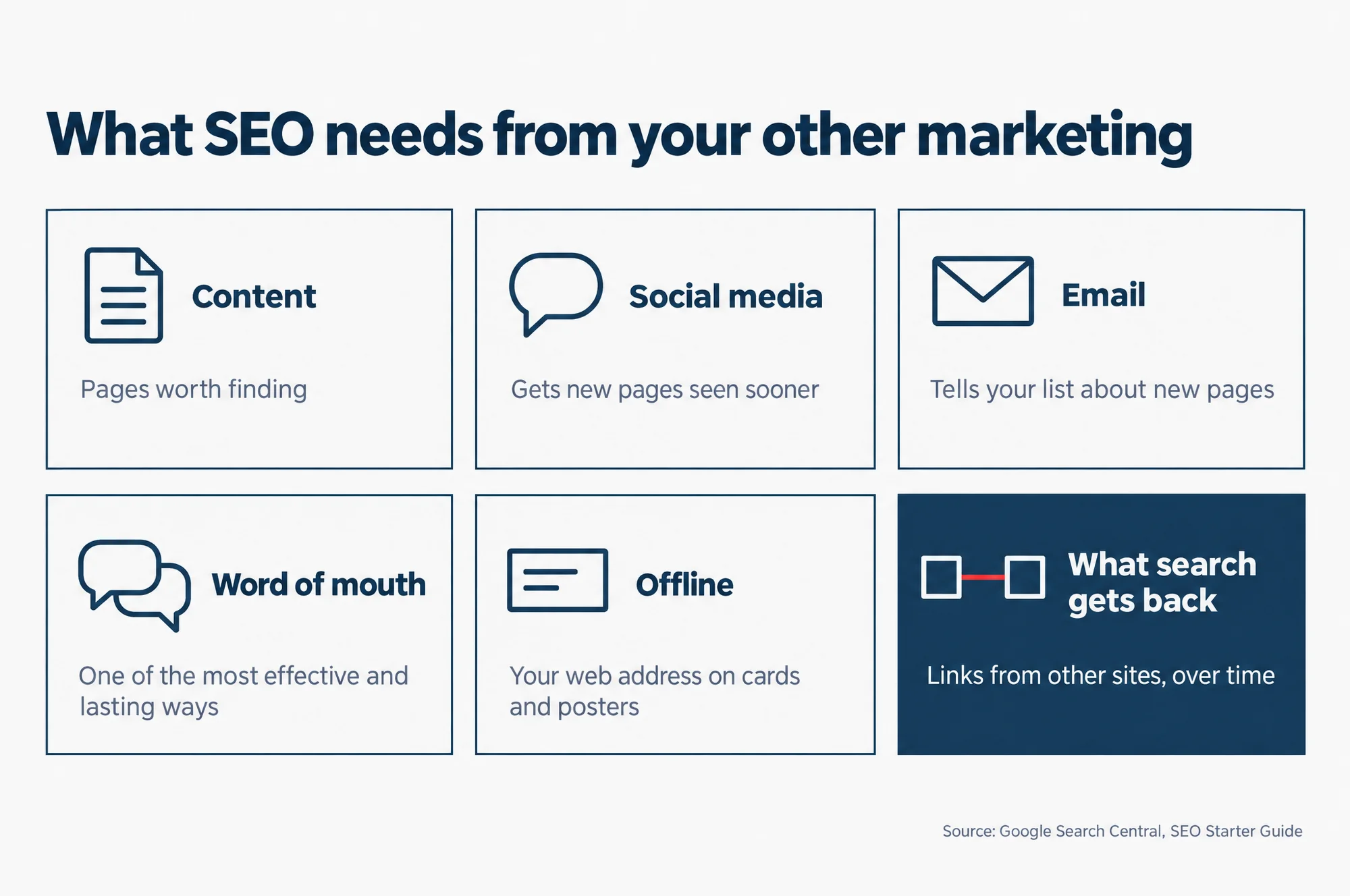
What SEO needs from your other marketing
- Content: Pages worth finding
- Social media: Gets new pages seen sooner
- Email: Tells your list about new pages
- Word of mouth: One of the most effective and lasting ways
- Offline: Your web address on cards and posters
- What search gets back: Links from other sites, over time
Source: Google Search Central, SEO Starter Guide
What should you do first when one person runs all the marketing?
Start from where your business is now, not from a list of search engine optimisation tasks. Pick one job, do it, and give it a few weeks. Google says “you likely want to wait a few weeks to assess whether your work had beneficial effects in Google Search results.”
| Where you are now | Do this first | Why it comes first |
|---|---|---|
| Customers come to your shop, clinic or office, or you serve one part of Singapore | Set up your free Google Business Profile, your business’s own listing on Google, then ask happy customers to leave a review | The profile shows on Google Search and Maps, and reviews are word of mouth that searchers can read |
| You have a website, but no idea what search sends you | Add Google Search Console and read the Queries tab | It shows which searches already find you, before you write anything new |
| You already post or send email every week | Turn the question customers ask most into one page on your site, then link to it from your next post and email | Your other channels then send people to something that can also show in search |
| You have useful pages, but few people know them | Share each page where your customers already are, and put your web address on your printed materials | Google says promotion leads to faster discovery, and links from other sites come over time |
Most small businesses fit more than one row. Start with the first row that fits, then work down.
The local row comes first for a reason. Google says “creating a Business Profile and listing your business on Google is free”, and that the profile lets you “manage customer reviews”. For a business with a front door in Singapore, it is the natural first step: it costs nothing, and it needs no new page on your website.
For the next steps with the profile, read our guide to Google Business Profile in Singapore and what moves you up on Google Maps.
You do not need a paid SEO tool for any row in this table. Search Console and Business Profile are both free. Search Console shows the searches that showed your site. Google says Business Profile lets you “Discover what keywords people search to find you”, meaning the words they type.
To start with Search Console, our guide to checking your website’s SEO for free with Google’s tools takes you through it.
Does search engine optimisation still bring visits now that Google shows AI Overviews?
Yes, though a search that shows one can send fewer clicks. AI Overviews are the short summaries, written by AI, that Google shows at the top of some search results, with links to pages that support them.
Google also has AI Mode, an AI feature in Search for questions that need more digging or comparing. Google says the same SEO work applies to both: “The best practices for SEO remain relevant for AI features in Google Search (such as AI Overviews and AI Mode). There are no additional requirements to appear in AI Overviews or AI Mode, nor other special optimizations necessary.”
Indexed means Google has stored a page so it can show it in results. A snippet is the short description under a result’s link. To show as a link in an AI Overview, Google says “a page must be indexed and eligible to be shown in Google Search with a snippet”.
The clicks are the honest worry. Pew Research Center, a US research body, studied the web browsing of 900 US adults in March 2025. When they saw an AI Overview, they clicked a normal search result in 8% of visits. When they did not see one, they clicked a result in 15% of visits, nearly twice as often. That is US data from 2025, not Singapore.
Google reads it differently. It says that when people click from results pages with AI Overviews, “these clicks are higher quality (meaning, users are more likely to spend more time on the site).” That is Google’s claim about its own product.
You do not have to take either side’s word. Google counts visits from its AI features in Search Console, in the Performance report under the “Web” search type, the report’s default view. Your own numbers there will tell you more about your business than any study.
If you are still weighing whether the work pays, our answer to is SEO worth it when Google’s AI answers first takes that question on.
Where to go from here
If you will run the SEO yourself, read our three-month SEO plan for a small business next. It sets out three months of work a small business can run itself on Google’s free tools, one step at a time.
If you would rather hand it off, our SEO service covers “Technical foundation, keyword and content strategy, Google Business Profile, and reporting you can actually read.”